
Untouched Gems & Jungles
Let’s Talk and bond with the Chimpanzees and Nature
Bugoma Forest Reserve
Wild Place of Chimpanzees
Bugoma Forest officially known as Bugoma Central Forest Reserve is one of Uganda’s prominent tropical rainforests situated in Hoima District along the eastern edge of the Albertine Rift Valley close to Lake Albert. The forest covers an area of about 401–411 square kilometers stretching approximately 40 kms across the terrain landscape.

It was gazetted as a protected forest reserve in 1932 and currently managed by the National Forestry Authority. Bugoma Forest is connected to the Congo Basin lying East of Lake Albert along the Albertine Rift Valley. The Forest lies at a medium altitude with a humid tropical climate facing the Albertine Rift hence offering you stunning views of terrain landscapes and ecological diversity. The Forest is known as a semi-deciduous tropical rainforest including dense vegetation and layered canopy systems.
The forests include; canopy heights of 20–40 meters in undisturbed areas, Dominance of ironwood (Cynometra alexandri) and hardwood species such as Khaya, Albizia, and Ficus. In the forest are more than 220–260 species of trees and shrubs, making it one of the most botanically rich forests in Uganda.
Bugoma Forest lies at an elevation ranging from about 990 to 1,300 meters above sea level with rainfall between 1,250 mm and 1,625 mm annually. The Forest is known as a medium-altitude, semi-deciduous tropical rainforest with a dense canopy reaching 20–40 meters high.
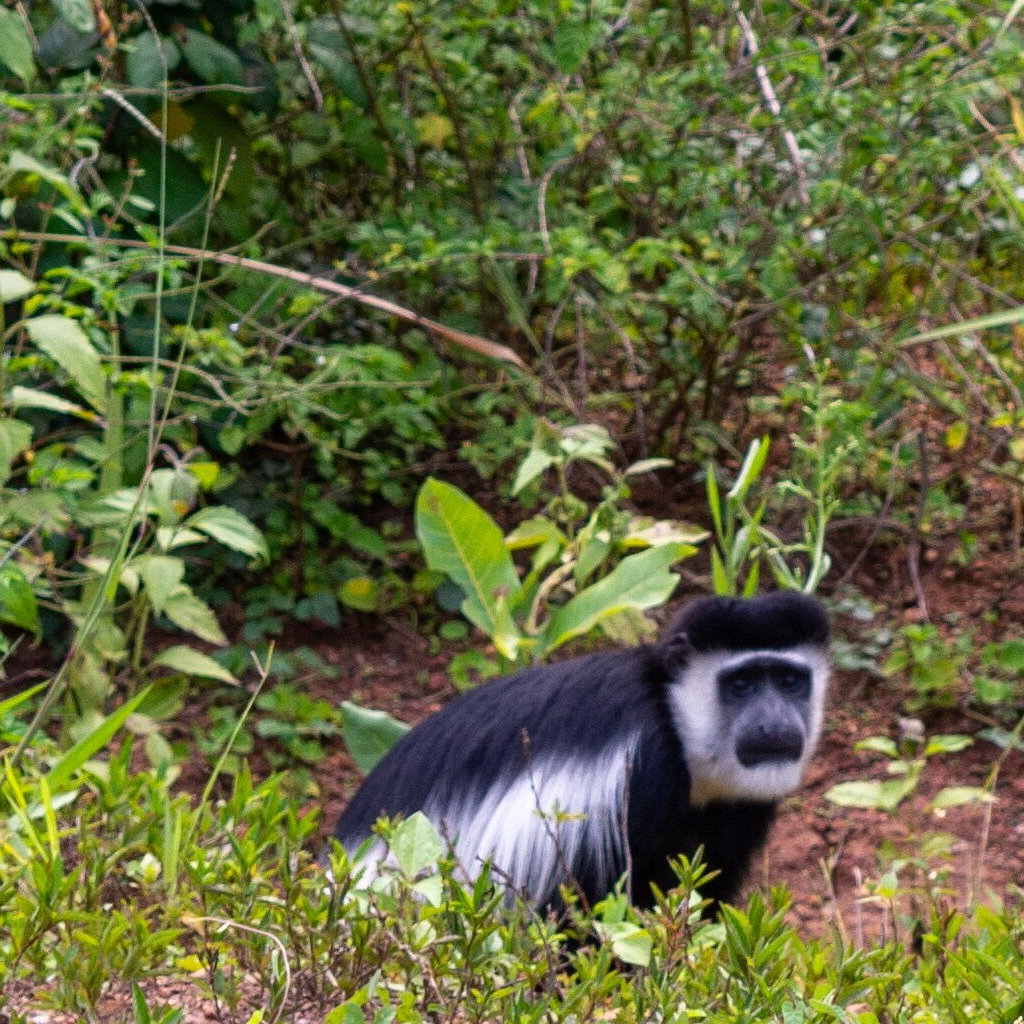
The vegetation around the forest includes; diverse plant communities like Dominant ironwood species (Cynometra alexandri), Valuable hardwoods like Khaya and Entandrophragma, Mixed tropical species such as Celtis, Albizia, and Ficus. Bugoma Forest inhabits 20 amphibian species, many reptiles and over 290 butterfly/ moth species. The mammals you watch include; 580 chimpanzees (Pan troglodytes), many black and white colobus (Colubus Guereza), Ugandan mangabey (Lophocebus Ugandae), red tailed monkeys, blue monkeys. The Ugandan mangabey that is only present in Bugoma.
The Forest also inhabits other animals like bush elephants, golden cats, side-striped jackals (Canis Adustus). The bird species you can watch in the forest include; the Little greenbul, Green hylia, Yellow billed barbet, Yellow –whiskered greenbul, Western Nicator, Buff-throated apalis, Yellow-throated Tinkerbird, Rufous flycatcher thrush, Olive sunbird, White-thighed hornbill, Black and white Casqued Hornbill, Black-billed Turaco, speckled Tinkerbird. There are also amphibians, reptiles and many insects, butterflies and moths.

Important Information:
- Booking Fee is US $30 per permit booked
- Refunding is not acceptable. (In case of rescheduling, an extra fee will be charged).
- Discounts are offered in case you are in a large group. (Booking fee will be US $65 per group)
- Purchasing a chimpanzee trekking Permit or a safari to the reserve does not come with a CAR.
Cost of Chimpanzee Trekking Permit
Bugoma Forest
Details
Foreign Non Residents —US $80 per person
Foreign Residents & East African Residents — US $65 per person
Chimpanzee Habituation Experience — US $150 per person


Eco-tourism in Bugoma Forest
Eco-tourism in Bugoma Forest is a conservation-driven approach that combines nature-based tourism, wildlife protection and community development. Unlike mass tourism, Bugoma’s Forest ensures that tourism activities directly support forest conservation and improve local livelihoods. Eco-tourism benefits local communities who provide guides and also are beneficiaries of the cost sharing income generated by the collection of activities fees US $5 per entry goes for conservation projects.
Eco-tourism activities in Bugoma were established in 2018 and offers responsible travel to natural forest environments that conserve biodiversity, support local communities and promote environmental education. Major activities that are done to promote eco tourism Include chimpanzee trekking, over 500 guided nature walks, bird watching, monkey trekking where you watch the Ugandan Mangabey.
The forest trails add up to 30kms long divided into the loops of over 200 m each having been developed. The site inhabits buffaloes, elephants, Ugandan Kobs and can be accessed through a dirt road 70 km from Hoima township.

Talk to Us Now
About Bugoma Forest
Bugoma Forest is a 41,144-hectare tropical forest in Western Uganda (Hoima/Kikuube districts) managed by the National Forestry Authority. It was founded in 1932 protecting over 600 chimpanzees, 34 mammal species, and 260+ bird species.
Bugoma Forest includes a medium altitude with and it is largely a semi-deciduous forest with iron wood also referred to the Muhimbi. In the forest are 4 small rivers that drain the vegetation and these include; River Sonso, River Rubwa, Wake and Waisoke. These rivers flow and empty their water into Lake Albert.
Bugoma Forest is a medium-altitude, moist, semi-deciduous tropical forest shaped by moderate rainfall (about 1,200–1,800 mm annually) and elevations between 990 and 1,300 meters. The vegetation of Bugoma is highly diverse with over 220–260 species of trees and shrubs making it one of the richest forests in the region in terms of plant composition. The forest is semi-deciduous in nature i.e some trees shed leaves during dry periods, others remain evergreen creating seasonal variations in the canopy cover.
The forest is typical of tropical moist forests that experience alternating wet and dry seasons. The vegetation is of stratified structure into layers i.e the Emergent layer with Trees that exceed 40 meters and these include; large hardwood species like mahogany, canopy layer (20–30 m) with dominant tree species that control light penetration, Understorey layer with smaller trees and shrubs that adapt to low light, Forest floor which include; Herbs, ferns, seedlings, decomposing organic matter.
From Hoima city, Bugoma Forest is 70kms away and it requires you to drive to the forest reserve from Kampala through Hoima-Fort Portal route and branch off to Kabwoya sub-country then finally Bugoma Forest passing through Kasindi Forest Station.
Getting to Bugoma Forest by Road
Main route from Kampala
Kampala – Hoima (via Kampala–Hoima highway)
Hoima – Kabwoya Sub-county
Getting to Bugoma Forest by Air
Air travel is possible to Bugoma Forest as you get domestic flights which depart from Entebbe International Airport/ Kajjansi Airfield to fly to Hoima Airstrip for about 1 hour to Bugoma Forest.
Tracking is the most prominent safari activity carried out in the park with two communities that have been habituated for trekking by all travelers. This is an alternative to Kibale Forest National Park. The trekking procedure here offers a quieter, less crowded adventure experience.
There are over 500-600 chimpanzees in the forest and these are trekked as you get to be briefed on conduct around the chimpanzees, rules and regulations around the chimpanzees
then later you shall trek the chimpanzees for a period of 2 to 4 hours.
En-route, you watch other primates like the red tailed monkeys, black and white colobus monkeys, Uganda mangabeys. After you shall meet the chimpanzees and stay in their presence taking photos in an hour to keep.
To participate, visitors must obtain a chimpanzee tracking permit which costs US $80 per person interested and this includes; Guided nature walk trek with the chimpanzees.
Best Time to Visit
Dry Seasons in the months of June – August and December – February.
Wet Seasons
In the months of March – May and September – November.
FAQs
Where is Bugoma Forest Found?
Bugoma Forest is located in the western part of Uganda. It is found in the Southwest of Hoima and northeast of Kyenjojo part of the Bunyoro region.What fauna species can I see there?
Besides chimpanzees, it is home to Black and white Colobus monkeys, Red-tailed monkeys, Blue monkeys, Vervet monkeys and grey-cheeked mangabeys.What is the best time to visit?
Bugoma forest can be visited anytime around the year although the best time to visit the forest is during the drier seasons so that you can navigate through the dense forest trails.Is it safe to visit Bugoma Forest?
Bugoma Forest area has faced tension due to conservation disputes with developers. However, it is a protected area under the National Forestry Authority (NFA) and tourism is actively managed in some zones.Talk to an expert
About Us
Bugoma Forest is a protected tropical rainforest located in Kikuube District (formerly part of Hoima District) in western Uganda. It is found in the Southwest of Hoima town and east of Lake Albert seating on on an escarpment within the Albertine Rift Valley about 70 kms from Hoima town. SITE MAPCopyright@2026 Bugoma Forest